
PRP & Regenerative Medicine — Treatment Plus The Rehab That Makes It Work
Platelet-rich plasma (PRP) therapy concentrates the platelets from your own blood and injects them into an injured tendon, ligament, or joint to concentrate growth factors at the site. At Pinnacle Performance & Wellness in Lubbock, Texas, PRP is prescribed by Stuart Riggins, FNP-C, after evaluation — and paired with a loading program run by Pinnacle's Doctors of Physical Therapy in the same building, which is what turns an injection into an outcome.
Medically reviewed by Stuart Riggins, FNP-C — Pinnacle Performance & Wellness, Lubbock, TX
The Basics
What PRP Actually Is
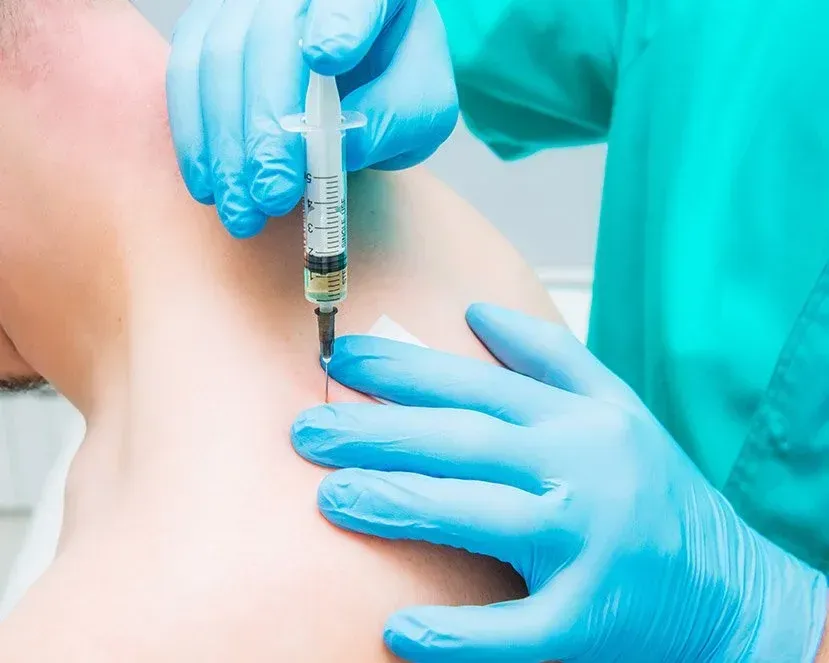
Blood is drawn from your arm, spun in a centrifuge to separate the platelet-rich fraction from red cells and most plasma, and that concentrate is injected into the target tissue — usually under ultrasound guidance for accuracy. Platelets carry growth factors involved in the body's own repair signaling. Concentrating them at a site that has poor blood supply, which describes most tendons, is the mechanistic rationale.
It is your own blood, so allergic reaction and rejection are not concerns. The realistic risk profile is what you would expect from any injection: soreness for a few days, bruising, small infection risk, and the possibility that it does not work for you.
Straight Answers
Where The Evidence Is Stronger, And Where It Is Weaker
Most clinics selling PRP present it as uniformly effective. It is not, and you should hear that from the clinic taking your money.
| Condition | Evidence | Realistic expectation |
|---|---|---|
| Lateral epicondylitis (tennis elbow) | Among the better-supported uses | Often meaningful improvement, typically over 2–3 months |
| Knee osteoarthritis (mild to moderate) | Reasonable support, mixed across trials | Symptom relief for a period of months; not cartilage regrowth |
| Patellar and Achilles tendinopathy | Mixed; results improve when combined with loading | Requires an eccentric loading program to be worth doing |
| Rotator cuff tendinopathy (partial) | Mixed | Reasonable option before considering surgery, not a substitute for one where structural repair is needed |
| Full-thickness tears, advanced bone-on-bone arthritis | Weak | We will tell you it is not the right treatment |
If your presentation sits in the bottom row, the recommendation here is a referral or a different plan — not an injection you paid for that was never going to work.
The Difference
The Part Most PRP Clinics Skip
An injection changes the biological environment for a window of time. It does not change how you load the tissue, and the loading is what remodels it. A tendon that was failing under demand before the injection will fail again after it unless the demand or the capacity changes.
This is where Pinnacle's structure matters more than any single treatment. Your PRP is scheduled with a rehab program built around it: relative rest for the first days, then progressive loading through the healing timeline, run by a DPT down the hall who can see the injection site, knows the protocol, and progresses you on measured criteria. A standalone injection clinic hands you a post-procedure sheet and books your follow-up. That is the difference between the two models, and it is the reason this service exists inside an integrated clinic.
The Process
What The Process Looks Like
Evaluation
History, physical examination, review of imaging, and a determination of whether PRP is actually the right tool. Some patients are told it is not.
Plan
Target tissue, number of injections expected, the rehab timeline, and total cost, quoted before you commit.
Procedure day
Blood draw, centrifuge processing, and injection, typically 45–60 minutes in clinic. Anti-inflammatories are generally stopped beforehand because they blunt the intended response; your provider will give you exact instructions.
First 72 hours
Expect soreness at the site. That is anticipated, not a complication.
Rehab
The loading program starts on schedule with your Pinnacle DPT.
Reassessment
Most patients are assessed at 6 and 12 weeks. Response is usually gradual rather than immediate, and a second injection is sometimes indicated.
Common Questions
PRP FAQ
How much does a PRP injection cost in Lubbock?
Does PRP actually work?
How long does PRP take to work, and how many injections will I need?
Is PRP better than a cortisone shot?
What should I avoid before and after a PRP injection?
Book Your Appointment (806) 808-0606 · 8347 Upland Avenue, Lubbock, TX 79424
West Texas’s integrated human performance and wellness center. Clinical precision. Athletic methodology. One system.
8347 Upland Ave · Lubbock, TX 79424
Office hours:
Monday to Thursday: 8am - 5pm
Friday: 8am to 12pm
Saturday: By appointment
Sunday: Closed
© 2026 Pinnacle Performance & Wellness, LLC · Lubbock, TX
Disclaimer
All information on this website is intended for instruction and informational purposes only. The authors are not responsible for any harm or injury that may result. Significant injury risk is possible if you do not follow due diligence and seek suitable professional advice about your injury. No guarantees of specific results are expressly made or implied on this website.